


Tight hips after driving, stiff shoulders from desk work, and sore calves after exercise can come from ordinary muscle guarding, but the same complaint can also signal an injury or nerve problem. You will learn how Thai massage works, when it is a reasonable option, what to ask for, and when a doctor or physiotherapist is the safer choice.
Key takeaways
- Thai massage may ease stiffness linked to sitting, driving, exercise, or muscle guarding.
- Tell the therapist about pain, injuries, health conditions, and pressure limits before starting.
- Seek medical assessment first for sudden, severe, worsening, or unexplained stiffness.
- Ask for slower stretching, lighter pressure, and breaks whenever a movement feels unsafe.
When Thai Massage May Help Common Muscle Stiffness
Thai massage therapy can temporarily ease common muscle stiffness after sitting, driving or exercise, particularly by reducing guarding and making movement feel more tolerable. Thai massage therapy for stiff muscles in Katraj is assisted stretching and pressure-based bodywork, not simply a passive oil massage.
| Situation | What it may do | What it cannot do |
|---|---|---|
| Hip, hamstring, calf, shoulder, neck or lower-back stiffness | Use palm, thumb, forearm, elbow or foot pressure with assisted stretches and joint movement to improve short-term movement tolerance | Guarantee lasting relief or identify the cause |
| Torn muscle | Avoid stressing an injured area while it heals | Repair the tear |
| Arthritis | Temporarily reduce surrounding muscle tightness | Reverse joint changes |
| Nerve compression | Possibly relax nearby muscles if pressure does not worsen symptoms | Remove compression or treat nerve damage |
Research supports short-term, condition-specific benefits for some musculoskeletal complaints. It does not prove that Thai massage is better for every case than stretching, exercise, physiotherapy or another massage method.
Do not work through sharp, burning or electric pain, tingling, numbness, radiating pain or pain that worsens during a stretch. Stop and report it; vigorous pressure can cause soreness, bruising, dizziness or increased pain. The underlying cause matters more than the massage label.
What Happens During a Thai Massage Session
Expect to remain in loose, comfortable clothing rather than undressing for an oil massage. Your practitioner will usually work on a padded floor mat or a suitable massage table, after asking where stiffness occurs, what movements feel limited and what pressure you accept.
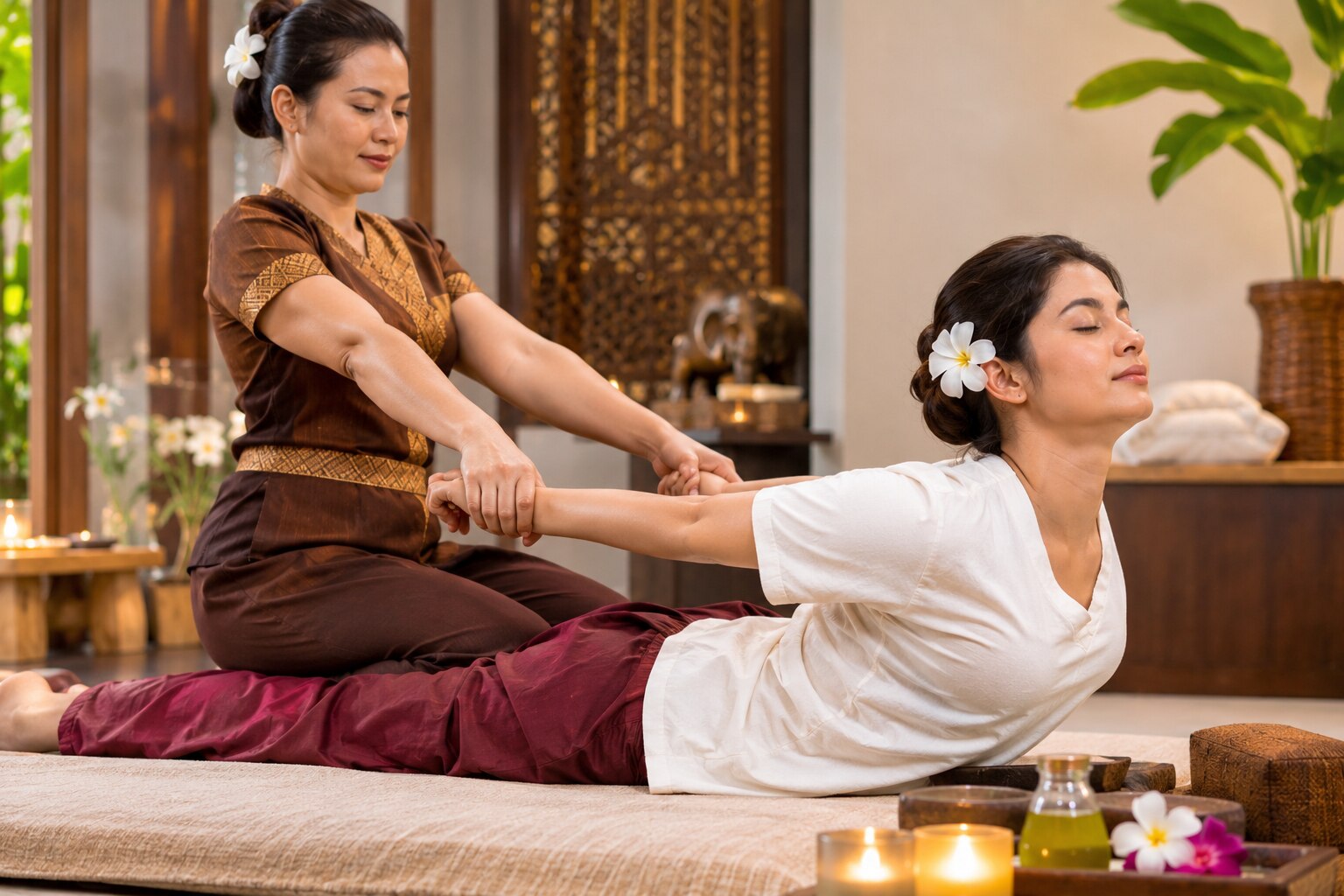
Thai massage therapy combines palm, thumb, elbow, forearm or foot compression with therapist-assisted stretches and gentle joint movements. You stay involved: the practitioner may guide your arms, legs or spine through yoga-like positions while changing pressure and stretch intensity in response to your feedback.
Oil may not be used, although the provider should explain any variation before starting.
| Approach | What happens during treatment | Focus for restricted movement |
|---|---|---|
| Thai massage | Clothed compression, assisted stretches and guided joint movement | Active mobility and tolerance to stretching |
| Passive relaxation massage | You remain still while the practitioner works on the muscles | Relaxation with little effort or movement from you |
| Swedish massage | Usually lighter gliding, kneading and rhythmic strokes, often with oil | General relaxation and surface muscle comfort |
| Deep-tissue massage | Slower, more forceful pressure into selected tissues | Persistent tight-feeling areas, with greater soreness risk |
Thai massage is not automatically better than the other options. Choose a style that matches your tolerance, symptoms and goal; forceful stretching is a poor fit when movement is painful or an injury is possible.
Stop the session if you feel sharp, burning or electric pain, numbness, dizziness, joint instability or pain travelling down an arm or leg. A good practitioner adjusts or stops rather than insisting on a fixed strong-pressure routine.
When Stiffness Needs Medical Assessment Before Massage
Postpone Thai massage therapy and seek a doctor or physiotherapist when stiffness comes with warning signs rather than ordinary muscle tightness. Massage can aggravate an injury, delay diagnosis or worsen bleeding when the cause has not been identified.
| Finding | What to do | Why it matters |
|---|---|---|
| Severe or unexplained pain, fever, unexplained weight loss or severe night pain | Do not book massage; arrange medical assessment | These symptoms can signal infection or another underlying illness |
| Major swelling or redness, contagious skin condition, open wound, or recent significant trauma | Wait for clinical advice and healing | Pressure can spread infection or worsen tissue damage |
| Recent fracture or surgery | Obtain clearance before treatment | Healing bone and surgical tissues need protection |
| New weakness, numbness, tingling, pain travelling down an arm or leg, or loss of bladder or bowel control | Seek prompt medical care; use urgent care for bladder or bowel changes | These can indicate nerve or spinal involvement |
| Anticoagulant use, a bleeding disorder, osteoporosis, blood-clot risk or uncontrolled high blood pressure | Ask your doctor before any vigorous massage and disclose the condition | Compression, stretching and position changes can create avoidable risk |
Pregnancy requires a therapist trained in prenatal massage, with positioning adapted to the stage of pregnancy and your symptoms. Forceful abdominal work, aggressive stretching and uncomfortable positioning are not appropriate substitutes for prenatal precautions. Tell the therapist about pregnancy before booking and stop if you feel pain, dizziness, breathlessness or unusual discomfort.
How to Choose and Control a Thai Massage in Katraj
Compare a thai massage near me, massage near me and body spa near me by asking what happens before you book, not by relying on star ratings or the word “spa.”
| Option | Check before booking | Warning sign |
|---|---|---|
| Thai massage near me | Thai-specific training, assisted stretching, pressure changes | Fixed strong-pressure routine |
| Massage near me | Practitioner training, health-history questions and clear session length | No questions about your symptoms |
| Body spa near me | Hygiene, private changing arrangements and price confirmation | Vague fees or shared changing space |
Use this checklist:
- Ask about training, clean linen, hand hygiene and how equipment is cleaned between clients.
- Confirm the session length, total price and any extra charges before treatment begins.
- Explain where the stiffness occurs, when it started, what worsens it, recent exercise, injuries, medical conditions and medicines.
- Confirm that the practitioner will explain each technique, obtain consent and let you stop at any point.
- Request light-to-moderate pressure, gradual stretching and frequent check-ins if you are new, inflexible or sore after exercise.
- Choose a practitioner who adapts the session rather than repeating a fixed strong-pressure routine.
Stop immediately and report sharp, burning or electric pain, numbness, tingling, dizziness, joint instability or pain travelling down an arm or leg. Do not “work through” these symptoms.
Ashiyana Massage Parlour- 08048035632 is a local option to contact and ask these questions; its availability or name alone does not prove suitability.
Related service
Thai Massage Thai massage, which originated in India, has been around for over 2,500 years. View service → |
What Results and Aftercare Are Realistic
Movement may feel easier after Thai massage therapy, and tightness may temporarily ease as your muscles guard less. This is not a cure or a promise of permanent relief: lasting improvement depends on breaks from prolonged sitting, gentle active movement, adequate sleep and gradual strengthening.
Mild soreness can follow vigorous compression or deep stretching. Bruising, dizziness or increased pain can also occur, but symptoms should improve during a short recovery period rather than worsen.
- Seek medical advice if pain progressively increases, you cannot move normally, or soreness, dizziness, bruising or increased pain persists beyond a short recovery period.
- Stop self-monitoring and arrange assessment if stiffness keeps returning despite changing the provoking activity and following sensible aftercare.
- Ask a doctor or physiotherapist to assess persistent stiffness, because the cause could involve an injury, arthritis, nerve compression or another condition that massage cannot correct.
Resume ordinary activity gradually, avoid repeating the position or workout that triggered the tightness, and use comfortable active movement rather than forcing a stretch. If sitting, take regular standing or walking breaks; passive massage alone is unlikely to provide durable change while the trigger continues.
Exfoliating spa treatments work on the skin surface, not deeper muscle stiffness. Do not use scrubs or vigorous exfoliation over sunburn, an eczema flare, rash, broken skin or a fresh injury; they are not treatment for deeper muscle or joint problems.
Frequently asked questions
When may Thai massage help common muscle stiffness?
It may temporarily ease stiffness after sitting, driving, or exercise by reducing muscle guarding and making movement more tolerable.
What happens during a Thai massage session?
Thai massage uses pressure and assisted stretching, so you remain involved rather than receiving only a passive oil massage.
When does stiffness need medical assessment before massage?
Seek medical assessment before massage for sudden, severe, worsening, or unexplained stiffness, especially after an injury or with other concerning symptoms.
How can you control a Thai massage in Katraj?
Tell the therapist your pressure limit, painful areas, injuries, and preferred pace; ask them to stop or modify any movement.
What results and aftercare are realistic?
Expect temporary relief rather than a guaranteed cure. Drink water, move gently, and avoid forcing stretches after the session.